Online Exhibition - Indigenous Minnesota
Who Does the
USA Belong To?
The historic removal of Native Americans from wilderness and how this connects to ICE detainments in Minnesota today.
Arrow keys - click arrows - swipe
Chapter I - The Peoples
Who Lived Here
Before
Minnesota has eleven federally recognised Indigenous bands and communities. Four belong to the Dakota (Sioux) nation - the first known inhabitants, with archaeological evidence placing them here 9,000 to 12,000 years ago. Seven belong to the Anishinaabe–Ojibwe (Chippewa), who migrated from the Great Lakes and Canada.
The Sioux are the 5th largest tribe active in the US today. The Chippewa are the 4th. Together they form the core of Minnesota's Indigenous identity - yet both were subjected to systematic removal, legal dispossession, and cultural suppression across the 19th century.
Bdote Memory Map - Dakota community resource - bdotememorymap.org
Chapter II - Dispossession by Law
The Treaty Era
& Land Removal
Before European arrival, Native Americans numbered up to 10 million across the continent. By 1900, European colonisation had reduced that to around 300,000 - with approximately 130,000 in Minnesota. The Trail of Tears (1830–50) alone displaced around 60,000 people.
The U.S. government used the ideology of Manifest Destiny to justify westward expansion - centred on the subjugation and expulsion of Native peoples from their lands. Treaties were the legal instrument of this dispossession. In 1851, Dakota leaders signed at Traverse des Sioux ceding over 24 million acres. Many later said they had not understood what they were agreeing to. Secondary documents - appended after signatures - stripped the promised annuities. Within months the treaties were already broken.
GOVT
1851
Primary Source - Legal Document
Treaty of Traverse des Sioux
Click to read full context
CONG.
1889
Primary Source - Federal Legislation
The Nelson Act, 1889
Click to read full context
Chapter III - 1862
The U.S.–Dakota War
After years of broken promises, withheld food, and encroaching settlers, Dakota warriors rose up in August 1862. The war lasted six weeks. Its aftermath was catastrophic for the Dakota people. Click each point to expand.
Chapter IV - 1862–63
Internment at
Fort Snelling
Over 1,600 Dakota women, children, and elders were force-marched to a concentration camp below Fort Snelling, held through a brutal Minnesota winter. Hundreds died of disease and exposure.
"That winter was very cold. Many died. We were not allowed to leave."

Fort Snelling, Minneapolis
View on MNHS websiteHistoric Fort Snelling - built on Dakota sacred land, 1820
The ICE detention facility stands 5 minutes from this site today
Chapter V - Primary Sources
Visual Evidence:
The Ojibwe & Dakota
The Nelson Act of 1889 was intended to relocate all Anishinaabe people in Minnesota to the White Earth Reservation and sell off their vacated land to European settlers. The land bar below shows what this meant in practice - a collapse from near-total territory to a fraction within decades.
The paintings by Seth Eastman - a U.S. Army officer stationed at Fort Snelling - are among the most important visual primary sources documenting Dakota and Ojibwe life before widespread dispossession. They are deeply ambiguous: made by an agent of the same state that destroyed the cultures he depicted.
Ojibwe land holdings in Minnesota - before & after
Click the artworks to explore their context
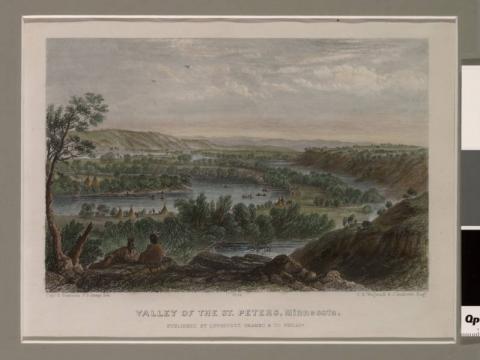
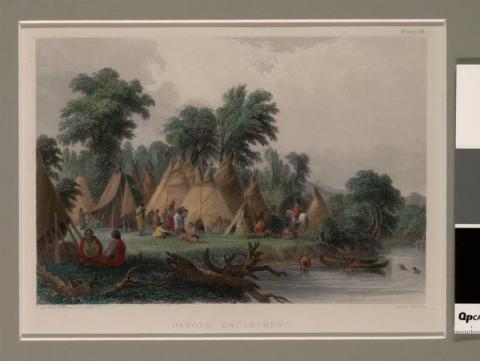
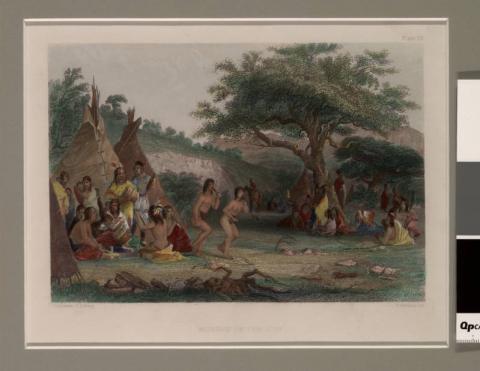
Chapter VI - Cultural Erasure
Civilise. Assimilate. Erase.
Federal boarding school policy forcibly removed Indigenous children from their families. The stated aim: "Kill the Indian, save the man." Children were forbidden to speak their languages, practice spirituality, or maintain contact with their families.
Click the words below to explore what was taken - and what survived.
Policy statement, 1892
"Kill the Indian in him, and save the man."
- Richard Henry Pratt, founder of Carlisle Indian School
Resilience & Survival
Despite systematic suppression, Dakota and Ojibwe cultures survived. Oral traditions, hidden ceremonies, and community networks kept languages and knowledge alive. Both nations now run their own language schools, cultural programmes, and tribal colleges.
Primary Source - Photography
The Stella Stocker Photography Collection (1858–1925) documents Ojibwe life in Minnesota during the boarding school era - providing a rare visual counterpoint to federal assimilation narratives.
View collection → Minnesota DigitalChapter VII - The Wider Context
How This Links
to Wilderness Thinking
The treatment of Native Americans today connects directly to the Eurocentric and exclusionary ideas of 19th and 20th century conservationists. The erasure of Indigenous history began with the rise of the conservation and preservation movements - and continues in American society today.
The removal of Native Americans was justified by the idea that it would better America - providing areas of "natural beauty void of human interaction" and enabling the frontier myth. This directly mirrors modern arguments that removing "illegal aliens" would make America more purely "American."
Two Eras, One Logic
| 19th C. Removal | 21st C. Deportation |
|---|---|
| Indigenous peoples framed as obstacles to progress | Immigrants framed as burdens on society |
| Narrative of the empty "wilderness" to be claimed | Narrative of an "American" identity to be protected |
| Law used to justify displacement of a community | Law used to justify removal of marginalised people |
| Indian Removal Act - executive authority to expel | ICE - executive authority to detain and deport |
"A pattern in how governments exercise power: who is included, who is excluded, and how law is used to make that exclusion appear legitimate."
Chapter VIII - 2025–2026
History Echoes
in Minneapolis
Operation Metro Surge - In early December 2025, 3,000 ICE agents were deployed to the Twin Cities of Minneapolis and St. Paul. The operation resulted in 3,700 arrests, 2 fatal shootings, 1 nonfatal shooting, and at least 33 wrongful detentions. The article that triggered the operation was later found to be exaggerated - its key source admitted finding "no evidence" of al-Shabaab claims.
Reports emerged that Oglala Sioux tribal members - people with ancestral connections to this very land - were among those detained and questioned about their right to be here. The ICE detention facility sits five minutes from Fort Snelling, the same site used to intern Dakota people 163 years earlier.
Oral Testimony
Melvin Longclaw, a descendant of the Dakota people, gave his oral testimony based on stories he heard from his family as well as those he lived with in the Sioux Village in Canada - describing displacement, survival, and the unbroken connection to this land that no federal act could sever.
- MNHS Oral History Collection
| 19th Century | Today, 2026 |
|---|---|
| Treaties signed under coercion strip Dakota of land rights | Legal status used to justify removal from communities |
| Fort Snelling used to intern 1,600+ Dakota people | ICE facility built 5 minutes from Fort Snelling |
| Dakota exiled from Minnesota by executive order | Indigenous tribal members detained on ancestral land |
| Federal government defines who belongs on the land | Federal government defines who belongs on the land |
Final Thoughts
Who really has the right
to be on this land?
Minnesota was built on land taken from the Dakota and Ojibwe peoples through broken treaties, military force, and law. The same government that removed them is now deciding who else gets to stay. Operation Metro Surge happened on stolen land, five minutes from the site where Dakota people were interned 163 years earlier.
This project was made to raise questions about what American citizenship actually means, and who gets to claim it. We think that story starts here, with the people who were on this land first.
Exhibition Sources
Bibliography
Primary Sources
Nelson Act, 1889 (Fiftieth Congress, Session II, Ch. 24)
United States Statutes at Large, Vol. 25, p. 642. govinfo.gov
Treaty with the Sauk and Foxes, 1837
Digital Library of Native American Treaties, Oklahoma State University. dc.library.okstate.edu
Longclaw, Melvin. Oral Testimony (Dakota descendant)
Minnesota Historical Society Oral History Collection. mnhs.org
Seth Eastman: Depictions of Native American Life
Minnesota Digital Library, Primary Source Sets. mndigital.org
Stocker, Stella Prince (1858–1925). Photography Collection on the Ojibwe in Minnesota
Minnesota Native American Newspaper Archive
Minnesota Historical Society. newspapers.mnhs.org
"Oglala Sioux Tribe says it cannot confirm tribal members were detained by ICE in Minneapolis"
MPR News, 16 January 2026. mprnews.org
Bdote Memory Map
Dakota community interactive resource. bdotememorymap.org
Ojibwe Primary Source Guide
University of Minnesota Duluth Libraries. libguides.d.umn.edu
Dakota Wicohan - Documentary Film on the Dakota People of Minnesota
Secondary Sources & Museum Resources
Anderson, Julie Humman. Reconciling Memory: Landscapes, Commemorations, and Enduring Conflicts of the U.S.-Dakota War of 1862
Secondary monograph.
Bishop, Harriet. Dakota War Whoop: Or, Indian Massacres and War in Minnesota, of 1862–3
Historical account, 1863.
Dowlin, Sheryl L. and Bruce Dowlin. Healing History's Wounds: Reconciliation Communication Efforts to Build Community Between Minnesota Dakota (Sioux) and Non-Dakota Peoples
Academic article.
Graves, Kathy Davis. Indians in Minnesota
Reference work on Minnesota Indigenous communities.
Mniyo, Samuel I. and Robert Goodvoice (ed. Daniel M. Beveridge with Jurgita Antoine). The Red Road and Other Narratives of the Dakota Sioux
Foreword by David R. Miller.
Minnesota Historical Society. Fort Snelling
Minnesota Historical Society. Fort Snelling: Dakota People
Minnesota Historical Society. Mille Lacs Indian Museum and Trading Post
Bell Museum, University of Minnesota. Reduced-Price Admission for Indigenous Peoples
National Park Service. "What Happened on the Trail of Tears"
Carleton College. Research Guide on Indigenous People in Minnesota